
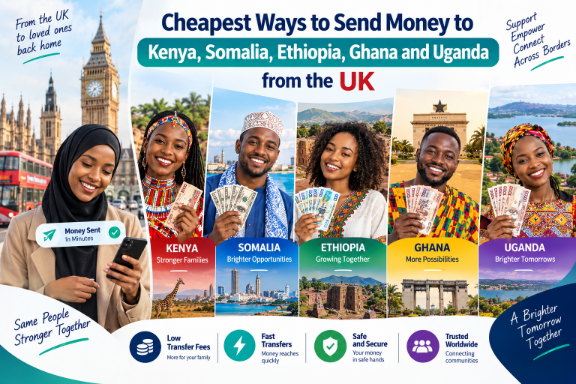
Cheapest Ways to Send Money to Kenya, Somalia, Ethiopia, Ghana and Uganda from the UK
If you send money home regularly, you already know that two providers can quote the same fee and still leave your family with very different amounts. That is because there's more to the fee than there seems to be. The other half is in the exchange rate, and that side is seldom revealed to you initially. This guide explains what makes a transfer cheap and then will explore the specific quirks in Kenya, Somalia, Ethiopia, Ghana and Uganda, where each corridor is unique.
The fee is not the full cost
The majority of buyers just think about the cost. It is the easiest number to believe and that's the number we rely on. Sadly, it is the most convenient number for providers to tinker and tweak.
This is how it works. A zero fee may be advertised by a provider, but it's simply a disguised lower exchange rate than the actual mid market rate, which is the true middle rate between the market rate at which one currency can be bought for the other and at which one currency can be sold for the other.
The difference between the mid market rate and the rate you receive is known as the spread and can cost you a lot more than any fee ever could.
So the real question is not "what is the fee?" It is "how much will my family actually receive?" That single figure, sometimes called the payout amount, is the only number worth comparing across providers.
Three things determine that number every time:
-
The fee charged by the provider
-
The exchange rate applied to your transfer
-
Any charges taken out on the receiving end, which happens more often than people expect with bank deposits in particular
Once you start comparing based on payout amount rather than fee, providers that looked cheap suddenly do not, and providers you had dismissed sometimes turn out to be the better deal.
Kenya: mobile money changes the maths
M-Pesa is one of the most successful mobile money solutions in the world and Kenya has one of the most advanced mobile money markets. This is important to you because transferring to a mobile wallet is typically quicker and less expensive than a bank deposit, and it will not incur any correspondent bank fees that some may be unaware of and that can eat into funds deposited in a bank account.
When looking for the most reliable provider for Kenya, you should consider three things:
1. The method of payment (M-Pesa or bank transfer)
2. The transfer time the provider claims
3. The exchange rate they quote and whether it is close to the mid market rate when you compare it to a free currency converter online (which gives you that reference number in seconds).
SafariRemit and all major providers offer direct support for M-Pesa payout so that you can do it within minutes after you get a payout confirmation.
Somalia: name matching is not optional
Somalia is an exception, as bank transfer is not the preferred payment method for most households, as mobile wallets and cash pick-up are more prevalent. Wallets are generally expected to be EVC Plus, Golis, E-Dahab and Premier Wallet with different speed of payouts between the different wallets, some paying out in minutes, others in a working day or two.
The mistake people make here is the name of the recipient. The name registered under the wallet/ID must be exactly the same as you type in when sending. If the customer account is registered under the name "Mohammed," but you type it as “Mohamed,” then any transfer to that account will be pending for days until you get it sorted out with customer service. This is a minor nuisance, but it's the most frequent reason for delays on this corridor, so make sure to double check spelling before sending.
Ethiopia: fewer options, so compare carefully
Remittance services in Ethiopia are more tightly regulated than in some of its neighbouring countries, which can make it seem more limited and fewer providers are available. Bank deposit and cash pickup are the safest means of getting settlement; mobile money is still increasing but is not as popular as in Kenya.
The provider list isn't as long, which is why it's imperative to be even more careful about the exchange rate, rather than assuming the market is competitive enough to get everyone to play fair. See the quote, compare it to the mid market rate and if it reads as if it could not possibly be any wider, then it is probably the widest.
Ghana: mobile money and bank transfer both work well
Ghana is in the middle of the pack between Kenya and Ethiopia. Mobile money, such as MTN Mobile Money, Vodafone Cash and AirtelTigo, is now booming and is now the preferred mode of payment for many households, alongside bank transfers.
In Ghana, mobile money transfers are generally quicker (generally arrive in minutes) than bank transfers (which may take a day or more, depending on the bank receiving the funds). If your recipient already has a mobile wallet, it is usually the easier and less expensive choice; if he or she doesn't use a mobile wallet, that's okay as well, but add a day or so.
Uganda: mobile money is the default, not the alternative
Uganda has adopted mobile money just as much as Kenya, so that most people receive transfers via MTN Mobile Money and Airtel Money in particular. While bank transfer remains available and convenient for larger amounts of money, particularly when paying business or school fees, mobile money is often faster and more convenient for the recipient of the transfer for everyday remittances.
One thing to note when looking for the services that are offered in Uganda: some providers have a limit on how much you can send via a mobile wallet in one transaction; anything over that limit will necessitate a bank deposit. When sending larger amounts, make sure to check the limit before sending and not after it has been stuck.
A five minute method to find the cheapest provider
You do not need a spreadsheet to compare providers properly. This works in a few minutes:
-
Decide on the payout method first: mobile money, cash pickup or bank deposit, based on what your recipient can actually use.
-
Get quotes from two or three providers for the same amount, the same payout method and, where possible, the same funding method (debit card, bank transfer, and so on).
-
Write down the number each provider says your recipient will get; ignore the fee entirely at this stage.
-
Pick whichever number is highest. That is your cheapest option, full stop.
-
If you want to sanity check further, compare the quoted rate against the mid market rate to see how much spread each provider is taking.
That is genuinely all there is to it. The provider with the flashiest "zero fee" banner is not automatically the winner; the one that gets the most money into your recipient's hands is.
Common mistakes that slow things down
A few avoidable errors account for most of the delays people run into:
-
Entering a recipient name that does not match their registered ID or wallet name, which is especially common with mobile wallets and cash pickup
-
Assuming a zero fee transfer is automatically the cheapest, when the exchange rate may be quietly making up the difference
-
Not checking the final "recipient gets" screen before confirming, which is the only figure that actually matters
-
Choosing bank transfer purely out of habit, when mobile money would have been faster and just as secure for the recipient
Timing also affects your cost
The one aspect that people do not think about is not who they are sending with, but when. Exchange rates fluctuate daily and weekly as well and may change considerably if there has been any economic news released for the pound or the local currency.
Some habits to develop:
-
If you are sending the same amount of money regularly (e.g. school fees or rent support) watch the rate for a couple of days before you send the sum. A slight “suspense” of a day or two, when the rate is moving in your direction, can make a significant difference over a year of trading.
-
Bank transfers may take longer during weekends or public holidays (in the UK or country of destination). This is another advantage of mobile money and cash pickup, as it doesn't typically slow them down if speed is a concern.
-
If a provider allows you to lock in a rate in advance, and you're sending a bigger amount and aren't feeling confident about volatility, it may be advisable to do so, even if you pay a little more.
All of that doesn't imply that you have to fret over every transfer. If you send on payday and compare 2 or 3 providers correctly, you will be on the road to the top deal 90 percent of the time. If you send large or frequent quantities, the only small percentage that you need to know is the timing!
The bottom line
It's not complicated, but cheap does take a bit of looking past the number that is easiest to see. Regardless of which of the five corridors you are dealing with, you should be mindful of the following - choose the payment method your recipient can access, compare what you are receiving, not what you are being charged, and double check the information that is likely to cause delays, especially names in mobile wallets.
In addition to mobile money, a bank transfer and cash pickup, SafariRemit operates in all five countries, is regulated by the Financial Conduct Authority and the sign up process is easy. The first 3 transfers are free when signing up with the promo code 3FREE.